INDONESIAN HABITAT HISTORY
The journey towards a New Urban Agenda began in the 1960s until the early 1970s. At that time, urban areas began to experience a surge in population, which was caused by the movement of people from villages to cities. This migration occurred in line with improving economic conditions in urban areas and increasing poverty in rural areas. Apart from that, this increase in population is also caused by advances in medical science with the discovery of modern medicines and treatments, which have had an impact on reducing infant mortality rates and increasing life expectancy.
This increasingly rapid but unplanned pace of urbanization causes many problems in urban areas, for example the emergence of illegal settlements, the increase in slum areas, and the decline in the quality of life in urban areas. In developing countries, urbanization has encouraged the emergence of illegal or unlicensed settlements which often become targets for enforcement and eviction by city governments.
However, at that time the world still did not realize and globally acknowledge the problems that arise in urban areas. This is because two-thirds of the world's population is still in rural areas, so city life has not become the main focus. The world is still focused on increasing economic growth as a solution to reducing poverty levels and developing villages. At that time, the international community still had no experience in dealing with various problems that existed in cities due to urbanization. The world is not yet aware, moreover, that urbanization also has the potential to trigger the emergence and increase in poverty rates.
As time goes by and urbanization increases, people tend to shift to living in urban areas, which creates new pressures on the environment. Residential areas are becoming wider and growing rapidly. The challenges faced by urban residents are increasing, for example access to water, food availability, shelter, energy, transportation, employment, pollution, environmental protection, and mental health.
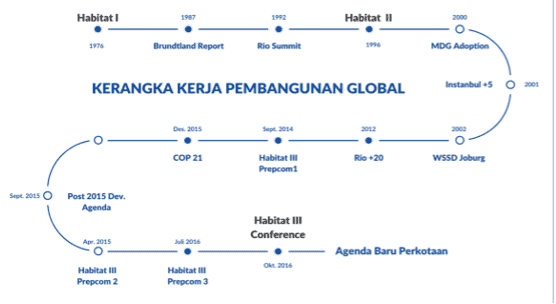
Global Development Framework and Roadmap for Habitat I to Habitat III
The increasing problems caused by uncontrolled urbanization, especially regarding environmental issues, have made world leaders feel that this is very important and complex. Moreover, because there was a request to hold a global meeting because there was a request to hold a global meeting to discuss these issues, a conference was held in Stockholm on 5-16 June 1972. This conference specifically discussed environmental problems, and focused on providing action guidance for national governments and international organizations to confront the problem.
Then in 1975, the UN assembly formed the United Nations Habitat and Human Settlement Foundation (UNHSF) under the umbrella of the United Nations Environment Program (UNEP). This organization was the first official UN body to deal with urbanization, and was also the forerunner of today's United Nations-Habitat (UN-Habitat). At that time, UNHSF was tasked with providing capital and technical assistance to national programs, especially in developing countries. After the formation of UNEP, in 1976 Habitat was implemented for the first time, as the UN Conference on Housing and Sustainable Urban Development which was held every 20 years.
Sunday, 26 May 2024
Profile
Publications

A Road Map Towards a Socioeconomic Development Plan for the Union of Municipalities of Qalaat El-Istiqlal
Read Now

Kilas Balik Habitat
Apa yang kerap orang pikirkan ketika mendengar kata “kota”? Mungkin yang terlintas pertama kali di pikiran ketika mendengar kata itu ad... Read Now


 Indonesia
 English